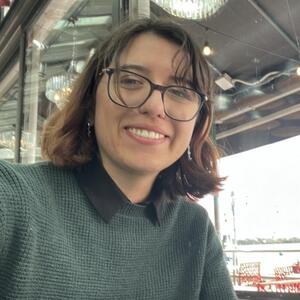
How advanced medical imaging can help us gain a deeper insight into patient-specific bone health

Date

Friday April 5, 2024
1:30 pm - 2:30 pm

Location

STI A

Danielle Whittier
Cumming School of Medicine, Department of Cell Biology and Anatomy,
University Calgary


Abstract

Osteoporosis is a condition often related to aging where bones become fragile and more likely to fracture during typical day-to-day activities. Approximately 1 in 2 women and 1 in 5 men will suffer an osteoporotic fracture in their lifetime. As our population ages and people live longer, the number of fractures due to osteoporosis are projected to increase dramatically over the next decade, overwhelming healthcare systems worldwide. However, it is notoriously difficult to identify who is at risk of fracture, and there is urgent need to improve diagnosis. In this talk will discuss how we found ourselves in this situation, and how advanced medical imaging combined with computational modelling can improve patient-specific assessment of bone health, and might help get us out of an imminent world health crisis.

Bio: Dr. Danielle Whittier is an Assistant Professor at the University of Calgary, specializing in advanced musculoskeletal imaging and computational modelling. She obtained her BSc in Engineering Physics at Queen’s University and a PhD in Biomedical Engineering at the University of Calgary. Her research seeks to characterize patient-specific bone health using advanced imaging, with particular focus on understanding the mechanisms leading to bone fragility and osteoporotic fracture. Her approach has led to identification of bone microarchitecture phenotypes across the population, and development of novel clinically oriented tools for predicting fracture risk.

Timbits, coffee, tea will be served in STI A before the colloquium.


IGnite: Research Stories to Inspire Generations

Date

Wednesday March 27, 2024
6:00 pm - 7:45 pm

Location

Kingston Public Library, 130 Johnson St. Kingston, ON. Register Here.

Kristine Spekkens
Queen's University, RMC

Daryn Lehoux
Queen's University


Event Information:

IGnite is free for all ages! We will have ASL services at this event for individuals who are Deaf and hard of hearing.

Be inspired by stories of discovery from researchers at Queen’s University. Kristine Spekkens and Daryn Lehoux will be telling their stories for a general public audience, well suited for high-school students and curious adults alike. No two scientists do the same research, and this event highlights the incredible diversity of academic interests and scientific talent in Kingston. IGnite hopes to be the spark that inspires you and your family to keep learning, and seek out answers to your own questions.

Kristine and Daryn will give a short presentation about what inspired them to do their research. Each speaker will be joined by a student researcher in their team, with time for questions from our inquisitive audience with priority to questions from our younger participants.

Dr. Kristine Spekkens is a cross-appointed faculty member at Queen’s University and RMC and works with some of the world’s largest and most advanced radio telescopes looking for cosmic gas and clues about the very nature of how galaxies like ours form.

Prof. Daryn Lehoux is head of the Department of Classics and Archeology at Queen’s University and is interested in a wide variety of topics. In anticipation of the upcoming total solar eclipse on April 8th, he will talk about how eclipses throughout history have contributed to humankind’s scientific knowledge.

The evening talks begin at 6:15 pm and are followed by a reception featuring a selection of displays and demos featuring research at Queen’s such as the dark matter experiment NEWS-G, the always popular particle cloud chamber from the McDonald Institute Visitor Centre, and opportunities to connect with the speakers and others who are doing inspiring research at Queen’s.

**Note tickets do not secure a seat during the talks, so please arrive early.**

**Photos will be taken at the event. Please let a member of the McDonald Institute Team know if you would like to not have your photo taken.**

Please contact us at Outreach@McDonaldInstitute.ca regarding accommodation needs or any other questions.

Our Facebook event can be found here.

This Event has ended.

Pushing the Edge of the Cosmic Frontier with JWST

Date

Friday March 22, 2024
1:30 pm - 2:30 pm

Location

STI A

Jeyhan Kartaltepe
Rochester Institute of Technology

Abstract

The James Webb Space Telescope (JWST) launched in December 2021, first started collecting data in June 2022,  and is already revolutionizing our understanding of the distant Universe. With its large segmented mirror, and optimization for infrared wavelengths, JWST was designed to detect and characterize some of the first galaxies to form in our universe and investigate how galaxies then evolve over the age of the Universe to the present day. In this talk, I will present how JWST has pushed our cosmic frontier beyond what was possible with Hubble and share some early results from extragalactic deep surveys and their implications for our understanding of the early universe.


Timbits, coffee, tea will be served in STI A before the colloquium.


Why are we here? Matter—Antimatter Asymmetry of the Universe

Date

Friday March 15, 2024
1:30 pm - 2:30 pm

Location

STI A

Dr. Seyda Ipek
Carleton University

Abstract

Everything around us, cookies, rocks, stars, galaxies... is made up of “matter” and not “antimatter”. We know that if antimatter comes close to matter, they annihilate each other leaving only energy behind. That we are here means there is no antimatter to annihilate with us. But what happened to the antimatter in the Universe? Where did it go? How did it disappear? Why/how did matter stay behind? I will talk about this mystery and possible ways around it, which requires new physics beyond the Standard Model of particle physics.


Timbits, coffee, tea will be served in STI A before the colloquium.


Constraining Ultra-Diffuse Galaxy Formation using Neutral Hydrogen (HI) Observations

Date

Friday March 8, 2024
1:30 pm - 2:30 pm

Location

STI A

Dr. Ananthan Karunakaran
Postdoctoral fellow, University of Toronto

Abstract

With the advent of modern wide-field sky surveys and improved astronomical instrumentation, we have been able to probe further down the galaxy luminosity and mass function. One of the most intriguing discoveries from the last decade in this regime is a large population of extremely faint, extended galaxies called Ultra-Diffuse Galaxies (UDGs). The sheer quantity and diversity of these objects have led to many follow-up studies, both observational and in simulations, to understand how these peculiar objects form and evolve. In this talk, I will present our efforts to constrain UDG formation and evolutionary mechanisms via neutral hydrogen (HI) observations. I will also briefly discuss some of the ongoing comparisons between our sample and hydrodynamical simulations before highlighting planned paths forward with next-generation facilities.


Timbits, coffee, tea will be served in STI A before the colloquium.


Astronomy On Tap Kingston - Sun vs Moon

Date

Thursday March 7, 2024
6:30 pm - 8:30 pm

Location

The Mansion - 506 Princess St, Kingston, ON K7L 1C5

Guest Speakers:
Gregg Wage (RMC/Queen’s), Chris Spencer (Queen's), with Mark Richardson as host (McDonald Institute/Queen’s)

Astronomy on Tap in Kingston is continuing in person!!

This free event is in the Living Room of The Mansion (506 Princess St, Kingston) on March 7th at 6:30 pm.

Astronomy on Tap is a series of worldwide events where professional astronomers give informal talks at a local bar on topics of a broad interest in astronomy and astrophysics. This particular event will be a bit different than in the past – we will host two fantastic astronomers & geologists: Gregg Wade and Chris Spencer who will go head-to-head in a debate over the sun vs moon in preparation for the April 8th total solar eclipse. The event will be hosted by local astro-buff, Mark Richardson. There will be time for questions and discussion, and the speakers and other local scientists will mingle with the audience between and after the talks, providing lots of opportunities to chat with some keen astronomers. There will also be a trivia session with questions related to astronomy with prizes given out to the winners!

The event is free and open to all ages. The Mansion serves alcohol and non-alcoholic drinks, and food will be available to be ordered.

Astronomy on Tap will be upstairs as you come inside.

Space is limited, so we encourage you to arrive on time! Pre-show starts at 6:30pm, with the main event starting at 7pm.

For more information or if you have any questions, please send us an email to Outreach@McDonaldInstitute.ca or contact us through our Facebook page.


Target Audience: Everyone welcome!

Hosted by: Queen's Physics Department & the McDonald Institute
Contact: AoTKingston@gmail.com

Lava Planets

Date

Friday February 16, 2024
1:30 pm - 2:30 pm

Location

STI A

Nicolas Cowan
Dept. of Earth and Planetary Sciences,
McGill University

Abstract

Three decades of searching  have revealed that planets are abundant in the Galaxy, but most are unlike those found in the Solar System. Lava planets are among the strangest exoplanets discovered so far. Their bulk density suggests an iron core surrounded by a rocky mantle, like Earth. But they orbit so close to their star that they are tidally locked into  synchronous rotation: their permanent dayside is hot enough to melt —and vaporize— rock, while their nightside is expected to be cold and airless. Until lava planets were discovered, nobody had imagined the wild geophysics of such an asymmetric world: supersonic silicate winds, and a permanent, hemispheric magma ocean. I will review current scenarios for the formation, interior structure, and atmosphere of lava planets, and how we are pushing back the boundaries of our ignorance with numerical simulations and astronomical observations.