
 Queen's 2015 Nobel Prize in Physics
National Research Council makes huge investment in Square Kilometre Array Observatory (SKAO)
![Stills/artist's impressions taken from animations of the SKA-Mid telescope in South Africa. [Credit: SKAO]](/physics/sites/physwww/files/uploaded_images/Images/News%20Images/Spekkens_SKA-Midtelescopes_1800x1200.jpg) Stills/artist's impressions taken from animations of the SKA-Mid telescope in South Africa.Stills/artist's impressions taken from animations of the SKA-Mid telescope in South Africa.
Stills/artist's impressions taken from animations of the SKA-Mid telescope in South Africa.Stills/artist's impressions taken from animations of the SKA-Mid telescope in South Africa.It is with great sadness that the Department of Physics, Engineering Physics & Astronomy announces the passing of Aubert Pereira. Mr. Pereira was with the department for over 20+ years. In the words of who knew and worked with him, he was a "real gentleman".

July 15, 2024
While the flight ended on June 3rd, the recovery crews reached the site only about a week ago due to the location's remoteness. Dr. Park's group met with Indigenous Peoples around Ellesmere Island in reflection of the HELIX's landing there. She and her team are demonstrating leadership in their field by asking some hard questions around research design, Indigenization, and respect for Indigenous Peoples in research.
June 12, 2024
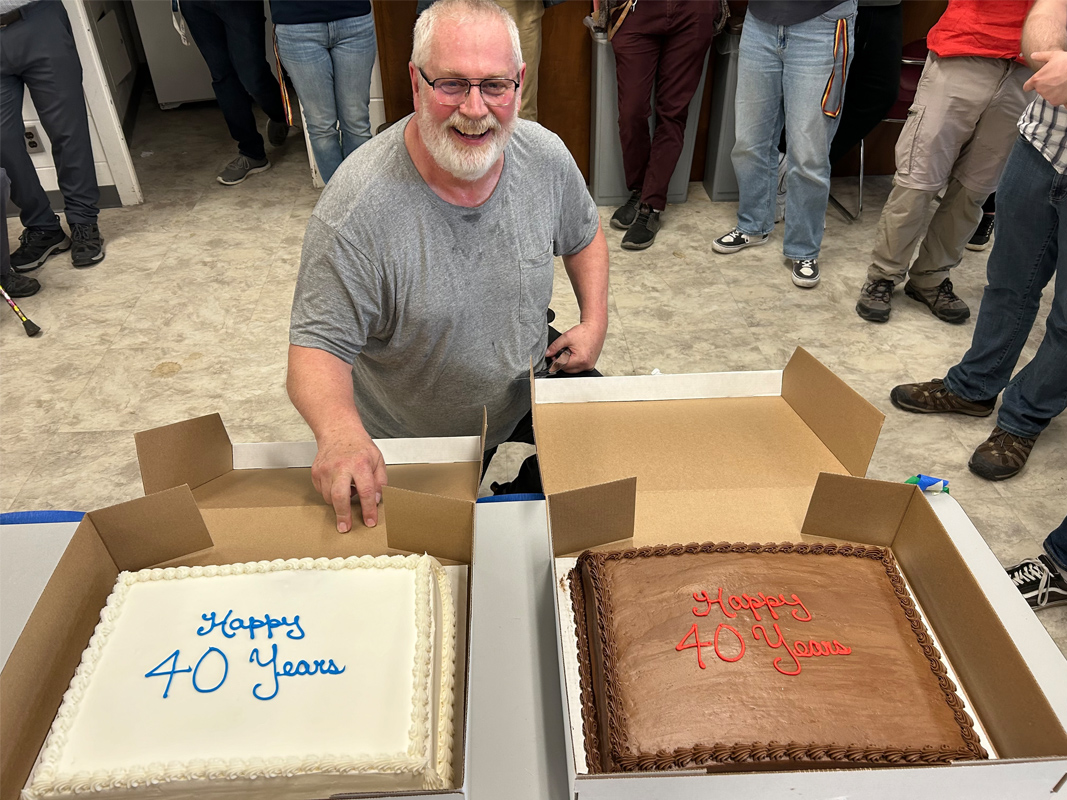
On May 15, 2024, the department celebrated Chuck Hearns
A new training program for highly qualified students and postdoctoral fellows will be developed in our Department following successful funding from the federal government’s Collaborative Research and Training Experience (CREATE) program. The program, entitled NUCLEUS (Network for Ultrafast Computing with Light on Emerging Unconventional Semiconductors), includes experts across six universities, numerous industry partners, and global academic entities.
Congratulations to the Queen’s Doctoral Internship in University Administration (QDIUA) Team, which won a Special Recognition for Staff award. This team includes Dr.
Congratulations to Drs. Nir Rotenberg, Greg van Anders, and
Congratulations to Dr.
Date
Friday April 26, 2024Location
STI AHistorically, quantum mechanics and computational chemistry has been unable to overcome the orthogonal requirements of speed and accuracy. If you want an accurate calculation, be ready to pay the price in computer time. In the pursuit of a compromise between speed and accuracy many approximations were developed that expedite ab initiomethods with some loss of accuracy.
We will present a deep learning model that approximates the solution of Schrodinger equation. Focusing on parametrization for organic molecules, we have developed a family of transferable neural networks models accurate compared to reference quantum mechanical calculations at speeds 10^6 faster. The tutorial presented here will provide attendees with the opportunity to learn how to perform molecular simulations with Python and PyTorch framework using Google Colab. No code installation is necessary. We will showcase calculations of chemical reactions, thermochemistry calculations, structural optimization, and molecular dynamics (MD) simulations.
Timbits, coffee, tea will be served in STI A before the colloquium.
![Graph shows Purcell factors (enhanced spontaneous emission rates) for a quantum dipole emitter placed inside the gap of a metal dimer cavity, in a finite gain medium (see cover), showing the usual local density of states (LDOS) values with small gain (a) [dashed line is no gain] and increasing amounts of gain (b), as well as (c) our corrected total Purcell factors that also include a non-local contribution fro](/physics/sites/physwww/files/uploaded_images/Images/Research%20Highlights/2024_OpticaQ_Vol2Iss2Cover.jpg)