Queen's 2015 Nobel Prize in Physics
Queen’s University Experimental Astroparticle Physics Group Accelerated Master’s Student Opportunities for 3rd Year Students
APPLICATION DEADLINE: Wednesday February 4th, 2026
APPLICATION DEADLINE: Wednesday February 4th, 2026
APPLICATION DEADLINE: Wednesday February 4th, 2026
Date
Thursday January 29, 2026
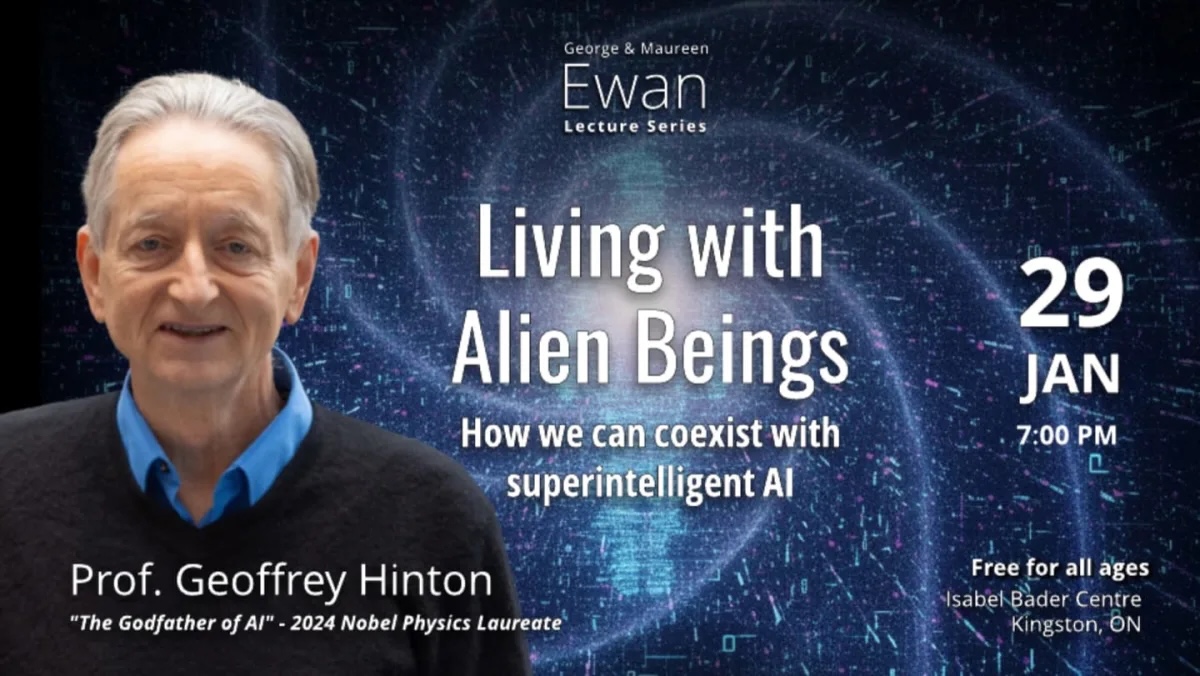
Artificial Intelligence, or AI, is quickly becoming an integral part of our digital world. Whether it’s as simple as summarizing search results or as complex as generating photorealistic images and videos, there is no question that these tools are significantly impacting our digital experiences.
Prof. Geoffrey Hinton (UofT) has had a long and productive career in machine learning and AI. In 1986, Hinton co-authored a highly cited paper on multi-layer neural networks, and he is considered a leading figure in machine learning, to the point of being referred to as one of the "Godfathers of Deep Learning." In 2024, Hinton was awarded the Nobel Prize in Physics jointly with John Hopfield for "foundational discoveries and inventions that enable machine learning with artificial neural networks."
We are thrilled to host Prof. Hinton in Kingston for the 2026 George and Maureen Ewan Lecture, a lecture series made possible by a generous endowment from the late Ewans, of which George was one of the founding members of the Sudbury Neutrino Observatory.
In his talk, Prof. Hinton will explain the various forms of AI, their potentials, and their limits. He will discuss the advancements and integrations of AI into our digital world and how we should anticipate potential intellectual and security risks.
Hosted by the McDonald Institute
APPLICATION DEADLINE: Friday, February 6, 2026
Supervisor: Dr. Judith Irwin
Department: Physics, Engineering Physics & Astronomy, Queen's University
Duration: May 1 to August 21, 2026
Date
Friday January 9, 2026Location
STI A
Last November was the 130th anniversary of the discovery of x rays by Wilhelm Conrad Röntgen in 1895. In the next months, the news of his discovery hit world attention. And less than two months after he produced what is considered the first anatomical x‑ray photograph of his wife’s hand, that experiment was reproduced in Canada on February 7th at McGill, and on the 17th in Kingston by a physicist from RMC.
In this talk I will present how the news of the discovery travelled via that era’s version of social media, and how the stage was set for Kingston’s and Canada’s x‑ray legacy.
L. John Schreiner retired as Chief of Medical Physics at the Cancer Centre of Southeastern Ontario in 2019, and is now Professor Emeritus of Oncology and Physics, Engineering Physics & Astronomy at Queen’s University in Kingston Ontario. He obtained his PhD investigating NMR relaxation in tissue model systems (Waterloo, 1985) and then joined McGill’s Medical Physics Unit where he initiated research in 3D dosimetry for radiation therapy quality assurance that spanned the rest of his career. His research extended to advancing Cobalt-60 teletherapy and investigating in-house end-to-end QA programs to ensure safe implementation and maintenance of clinical radiation therapy.
He has served the medical physics community as the Canadian Medical Physics newsletter editor, member of numerous Canadian Organization of Medical Physicists (COMP) committees, and as Canadian College of Physicists in Medicine board member and President. He was a founder and organizer for 14 International Conferences on Three Dimensional Dosimetry (IC3Ddose) meetings. He just stepped down as Past President of Medical Physics for World Benefit (MPWB) and will be editor of their newsletter. He has supervised over 120 trainees ( including 27MSc, 8PhD) introducing them to radiation therapy medical physics. And they enabled John to publish in ~120 peer reviewed publications. He has been invested as a Fellow of both COMP and the American Association of Physicists in Medicine (AAPM).
Timbits, coffee, tea will be served in STI A before the colloquium.
The Physics department helped sponsor one of our Mathematical Physics 4th year students, Don Kim, so he could travel to Germany. Here are some photos from Don and a little blurb about his trip:
Date
Friday November 28, 2025Location
STI A
Living organisms are much more than the sum of their parts and understanding how they work requires studying them over a vast range of time and length scales. Photosynthesis beautifully illustrates the challenges inherent in studying biological systems: on a femtosecond to picosecond time scale, light energy absorbed by a photosynthetic antenna complex is transferred through a maze of antennas to a “reaction center” where it is stored as stable charge separation that fuels the downstream processes of biomass production. While an isolated chlorophyll pigment will absorb sunlight, a photosynthetic complex achieves entirely new functionality through exquisite control of the local pigment environment and the relative spacing and orientation of the constituent pigments, tailoring the energy landscape to orchestrate, in time and space, the energy transfer and charge separation events that underlie photosynthesis. To capture the fastest dynamical processes in biology, multidimensional coherent spectroscopies provide the ability to initiate synchronized biological function in an ensemble of molecules, and monitor, with exquisite time resolution, the system evolution via its response to a carefully timed sequence of laser pulses. I will demonstrate how multidimensional spectroscopies can address open questions about photosynthetic systems and describe our recent progress in developing and using these tools to probe the mechanisms of ultrafast energy conversion in natural and artificial photosynthetic systems.
Jennifer P. Ogilvie is a Professor of Physics at the University of Ottawa. She received her B.Sc. from the University of Waterloo, her M.Sc. degree from Simon Fraser University, Canada, and her Ph.D. in Physics from the University of Toronto, Canada. She was an NSERC Postdoctoral Fellow in the Laboratory for Optics and Biosciences at the Ecole Polytechnique in Palaiseau, France. She began her independent career at the University of Michigan, Ann Arbor, and moved to the University of Ottawa in 2024. Ogilvie’s group develops coherent multidimensional spectroscopies and imaging methods and applies them to a wide range of biological and condensed phase systems. She is a Sloan Fellow and an Optica Fellow.
Timbits, coffee, tea will be served in STI A before the colloquium.
Date
Friday November 21, 2025Location
STI A
Small, temperate, rocky planets around low-mass stars are now known to be abundant in the solar neighborhood. Current occurrence-rate estimates indicate that a significant fraction (15– 50%) of M dwarfs host at least one planet in the habitable zone, raising the exciting possibility that a fraction of these worlds possess atmospheres and surface conditions suitable for liquid water. Among them, transiting systems are for now the easiest to study. Only a handful meet the stringent criteria of habitable-world candidates, that is planets in the habitable zone with precisely measured masses and radii, enabling detailed internal-structure models and constraints on their possible water inventories. The James Webb Space Telescope offers, for the first time, the capability to determine whether such planets retain an atmosphere through transmission spectroscopy and thermal-emission photometry, and to probe its composition if present. In this seminar, I will briefly highlight the current status of JWST observations of nearby rocky planets, along with essential complementary contributions from ground-based high-resolution spectroscopy, notably SPIRou and NIRPS. I will conclude with a perspective on the next major step: the characterization of nearby non-transiting habitable worlds with the European Extremely Large Telescope, poised to transform the exoplanet field in the next decade.
Timbits, coffee, tea will be served in STI A before the colloquium.