
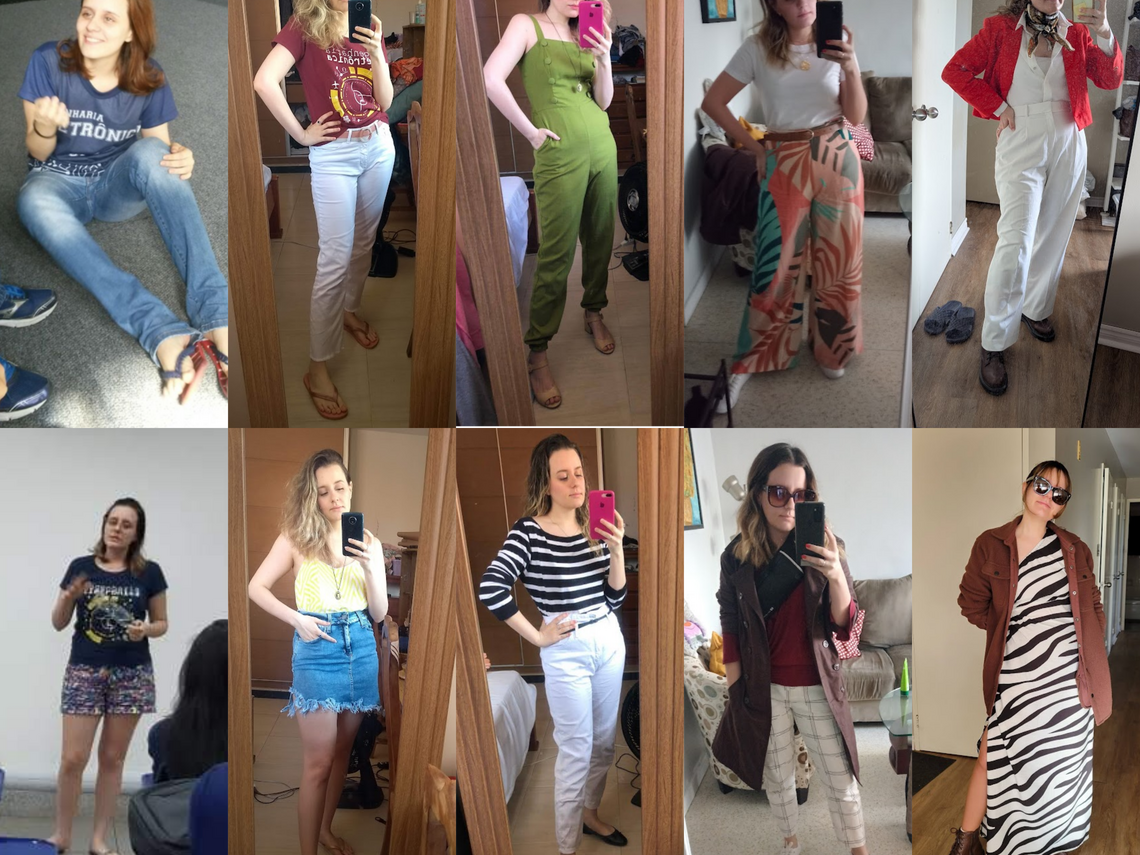
Image description: A five-stage visual timeline showing the evolution of the author’s personal style throughout her engineering education. Each column represents a different stage: 1) early undergraduate years, wearing a casual engineering-student uniform of university T-shirts, jeans or shorts, and flip-flops; 2) the COVID-19 pandemic, experimenting with more feminine and colourful outfits at home, including skirts, bright colours, and different hairstyles; 3) senior undergraduate years, after returning to in-person classes, with more expressive outfits incorporating colour, patterns, and feminine silhouettes; 4) master’s studies, showing a more polished and intentional personal style; and 5) PhD studies, featuring confident, distinctive outfits with bold patterns, accessories, and a more sophisticated style. Together, the photos illustrate a progression from blending in with the stereotypical engineering-student aesthetic to embracing a more authentic and expressive identity as an engineer.
For my first few years in engineering school, this was my uniform: jeans in winter, shorts in summer, a set of university T-shirts that could walk on their own, and flip-flops. Sound familiar? It's the unofficial dress code of every engineering building on my university back in Brazil. See? I belong here. I dress just like you.
Here's the thing nobody warns you about: blending in and belonging are not the same thing. I looked exactly like everyone else in my classes — all boys, mostly in the same three outfits on rotation. And for a while, that felt safe. If I dressed like them, maybe no one would notice I was the only woman in the room. Maybe no one would ask if I was "really" an engineer or assume I was lost on my way to a different building. Camouflage, basically. Very sensible. Very draining. Very lonely.
During the pandemic, when walls were always virtual, a very inconvenient question kept tapping on my shoulder amid many different circumstances: if I must disappear to fit in, is this actually fitting in? Or is it just hiding? And so, I started experimenting with my clothes, my hair (I dyed it pink!), and some makeup with no one around to judge me.
After a while, I found out the obvious: what you wear is not a distraction from being taken seriously as an engineer. It can be part of how you refuse to disappear. Going back to in-person classes right at the end of my degree, the simple act of wearing skirts truly started a movement, with other girls following my unintentional leadership and showcasing their own style, whatever it looked like. This isn't about mandatory glamour. It's about knowing you have a choice — the radical, small, daily choice to dress like yourself rather than like camouflage.
Because sexism in engineering doesn't only show up in big, dramatic moments; half the time it shows up quietly, in the assumption that to be credible you have to be “less” — unremarkable, unadorned, indistinguishable from the guy next to you. And that assumption is exactly what makes it so satisfying to break. You're quietly telling the room: engineers come in more than one costume.
It took me years to get here. It may sound silly, but it is so not. So, if you're part of any minority in engineering and in mid-identity-crisis, wondering if the "real you" are allowed in labs, lecture halls, conferences, and meeting rooms — here's your answer: yes. Let yourself be visible. Don't underestimate what it does for you to stop hiding. Confidence is contagious. So is visibility. Because every time one of us shows up looking unmistakably like ourselves, we're chipping away at the idea that competence has a dress code, skin colour, hair type, accent, or nationality.
Wear the colour. Wear the earrings. Or don’t. Just make sure whatever you're wearing, it's you.