
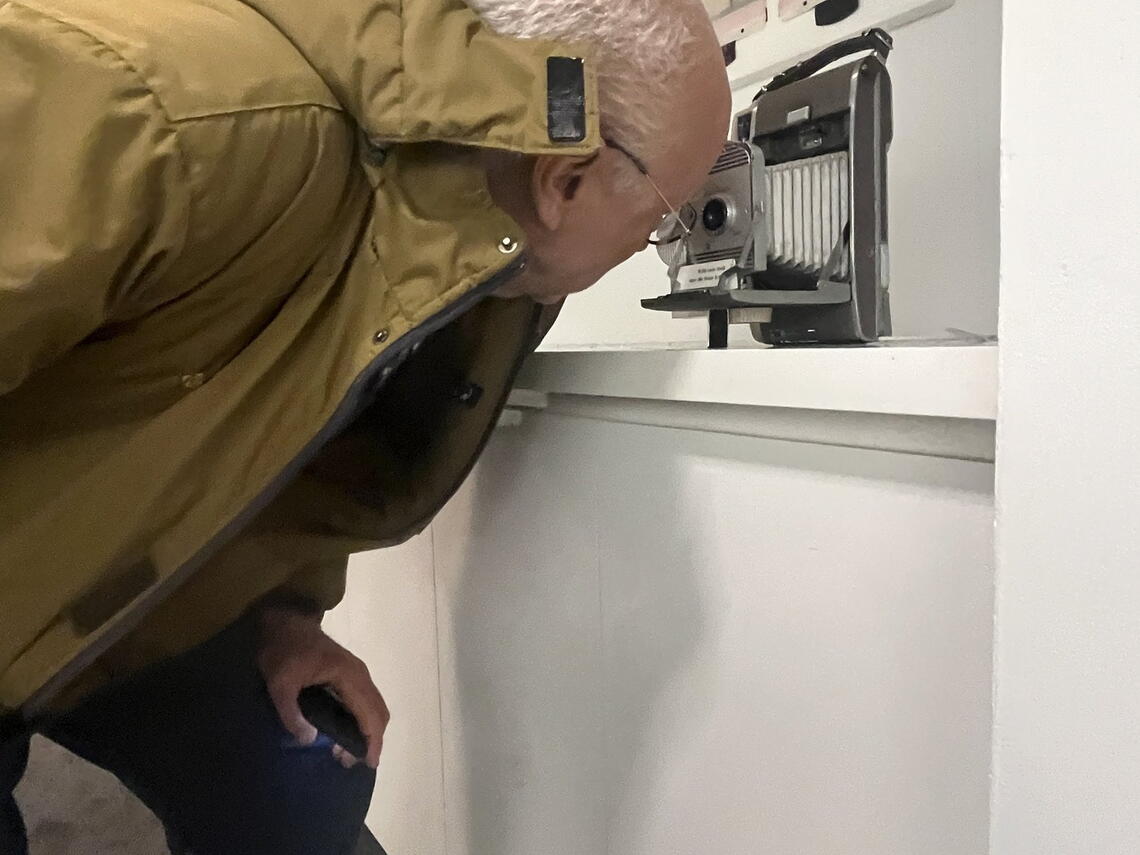
Image Description: A man wearing a yellow jacket looks into the front lens of a vintage camera in a gallery. Above the camera are two portraits of women facing away from the viewer, their hair styled in unusual, Medusa-like forms. These Hair Portraits by Rachel Portesi were featured in Vantage Point, an exhibition curated by Elyse Longair at Sotheby’s Institute of Art in 2025. A corresponding short film can be viewed through the camera lens. The image was chosen to illustrate the idea of looking at the world differently, much as Longair hopes her image theory encourages us to do.
Throughout graduate school, I have loved hearing about the diverse research areas that Queen’s has to offer. One area that I was unfamiliar with was Screen Cultures and Curatorial Studies. Luckily, I was able to ask some questions to one of our Graduate Student Ambassadors, Elyse Longair, to learn more about her experiences as a PhD student in the program.
For someone who is completely unfamiliar, what exactly is Screen Cultures and Curatorial Studies? And what do you research?
For me, screen cultures is about the world we live in, where many of our experiences are mediated through screens (e.g., TV, cellphones, computers, etc.). If any of you are theory nerds, you might be interested in reading Hito Steyerl’s Too Much World: Is the Internet Dead? (2013), which is still very relevant today. Many people in my program also approach screen cultures more in relation to film studies.
The question of curatorial studies continues to shift and evolve. Curating has become much more than putting art on the walls of galleries. Emelie Chhangur, the former director of the Agnes Etherington Art Centre here at Queen’s, is one of the leading voices in Canada rethinking how we understand curating. You can read a little more about her approach here.
My research practice builds on artist and theorist Marcel Duchamp, where I am developing an image theory in collage. Inframince/Infrathin/Infraslim Images examines a flat, seamless aesthetic where the thin space or gap between image fragments becomes less and less, nearly invisible. In this slim, infrathin space, the viewer can imagine freely the possibility of the image, and the roles of picture-making and imagination.
What is your favorite part about curating?
I’m thankful to have had some incredible curatorial opportunities, and I’ve learned and grown with each one. My favourite part has been connecting with the art, artists, galleries, and public on a personal level and building meaningful relationships and experiences.
What are some of the biggest skills that you have gained from doing art and curation? And how have these skills transferred over to your research?
I just came back from the University Art Association of Canada conference, where I presented on a panel arguing that my theoretical writing and creative practice go hand in hand, continually building on one another and remaining in constant dialogue. They’re embedded in one another and are best understood together in a relationship described as research-creation.
In terms of skills, I’m always growing, learning, and building new skills, whether that’s becoming better at putting words together in my writing, bringing images together through collage and curation, or presenting my work at conferences.
On a final note, are there any artists or creators you would recommend readers to check out?
Specifically in collage, artists whose work I research a lot include Max Ernst and his three collage novels: La Femme 100 têtes(1929), Rêve d'une petite fille qui voulut entrer au Carmel (1930), and Une semaine de bonté (1934). I’d also recommend Martha Rosler’s House Beautiful: Bringing the War Home series (1967–72) & (2004-08) and John Stezaker’s Masks.