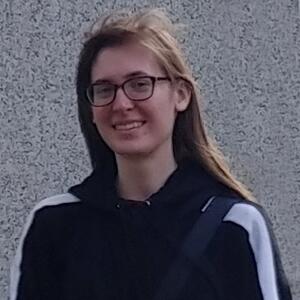
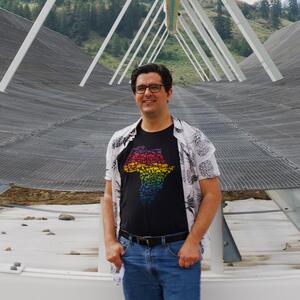
Sebastian Franke

Sebastian Franke

Sebastian Franke

Post Doctorate

Post Doctorates

Physics, Engineering Physics & Astronomy

Arts & Science

Area of Research

Supervisor: Prof. S. Hughes

Becca VanDrunen

Becca VanDrunen

Becca VanDrunen

MSc Candidate

she/her/hers

Graduate Students

Physics, Engineering Physics & Astronomy

Arts & Science

Areas of Study

Condensed Matter Physics & Optics, Theoretical and Computational Physics

Supervisor: Prof. S. Hughes

Becca's Social Media

Lucas Rantz

Lucas Rantz

Lucas Rantz

Accelerated MASc Candidate (Eng Phy)

Graduate Students

Physics, Engineering Physics & Astronomy

Arts & Science

19lkr2@queensu.ca

Phone: TBD

Office: TBD

Research Areas

researching how to optimize quantum systems using neural network architecture

Co-Supervisors: Prof. B. Shastri, Prof. Rotenberg


Tristan Austin

Tristan Austin working in the Shastri Lab at Queen's University, Kingston, Ontario

Tristan Austin

PhD Candidate

he/him/his

Graduate Students

Physics, Engineering Physics & Astronomy

Arts & Science

tna2@queensu.ca

STI 161A

Area of Study

Condensed Matter Physics & Optics, Engineering and Applied physics

Co-Supervisors: Prof. B. Shastri, Prof. Rotenberg

About Austin

Broad interests lie in various novel computing systems, and their unique applications; especially excited about quantum computing and quantum machine learning.


Faculty and Staff Awards

The Physics and Engineering Physics Department Student Council (DSC) organized a great banquet on Saturday April 1. Well over a hundred students, faculty and staff enjoyed getting together to celebrate the end of the school year – having a banquet for the first time in four years!

One major highlight was the return of awards for instructors as voted on by the students. Thanks to the DSC for organizing this!

Article Category

Accelerating quantum dynamics with long-range interactions

Date

Thursday March 30, 2023
2:30 pm - 3:30 pm

Location

STI B

Dr. Jeremy Young
Postdoctoral Fellow, JILA, NIST and the University of Colorado

Abstract

One of the major goals in the field of quantum science is to utilize the properties of quantum mechanics for applications in quantum computation, quantum simulation, and quantum sensing. In order to address this goal, a variety of different many-body quantum platforms have been developed. Many of these quantum platforms exhibit long-range interactions, particularly power-law interactions, including Rydberg atoms, polar molecules, trapped ions, among others. This gives rise to a natural question: how does the long-range nature of these interactions affect the resulting quantum evolution?

In this colloquium, I will discuss some of the ways that these long-range interactions have been utilized both for studying new many-body physics and for applications in quantum science. I will focus in particular on how long-range interactions can be used to accelerate entanglement generation in two contexts. First, I will illustrate how long-range interactions can be used to provide exponential speedups over short-range interactions in entanglement spreading and state transfer and discuss how this can be achieved with Rydberg atoms and polar molecules. Second, I will present an approach for engineering multi-qubit gates by dressing Rydberg atoms with coherent light, which provides a means for tuning the underlying Rydberg interactions.

Dr. Young is a candidate for the tenure-track faculty position in theoretical condensed matter physics or theoretical optics.  There are opportunities to meet with Dr. Young during his visit, please contact Melissa Balson to be added to the schedule.

Coffee, tea will be served in STI B before the colloquium.

Molecular Communication: From Theory to Practice

Date

Friday March 31, 2023
1:30 pm - 2:30 pm

Location

STI A

Andrew Eckford
York University

Abstract

How can we communicate using molecules? This question may unlock new applications in nanorobotics and medicine, but has only recently attracted attention from communication and information theorists. The answer to the question is surprisingly difficult: not only is the medium unfamiliar, but the mathematical details of the communication environment are complicated. In this talk, we present three examples to illustrate the current state of the field: for nanonetworking applications, we present the additive inverse Gaussian channel model; for biological applications, we discuss the information-theoretic capacity of intercellular signal transduction; and for experimental applications, we present a new low-cost, easy-to-use platform to evaluate macroscale molecular communication.

Timbits, coffee, tea will be served in STI A before the colloquium.