

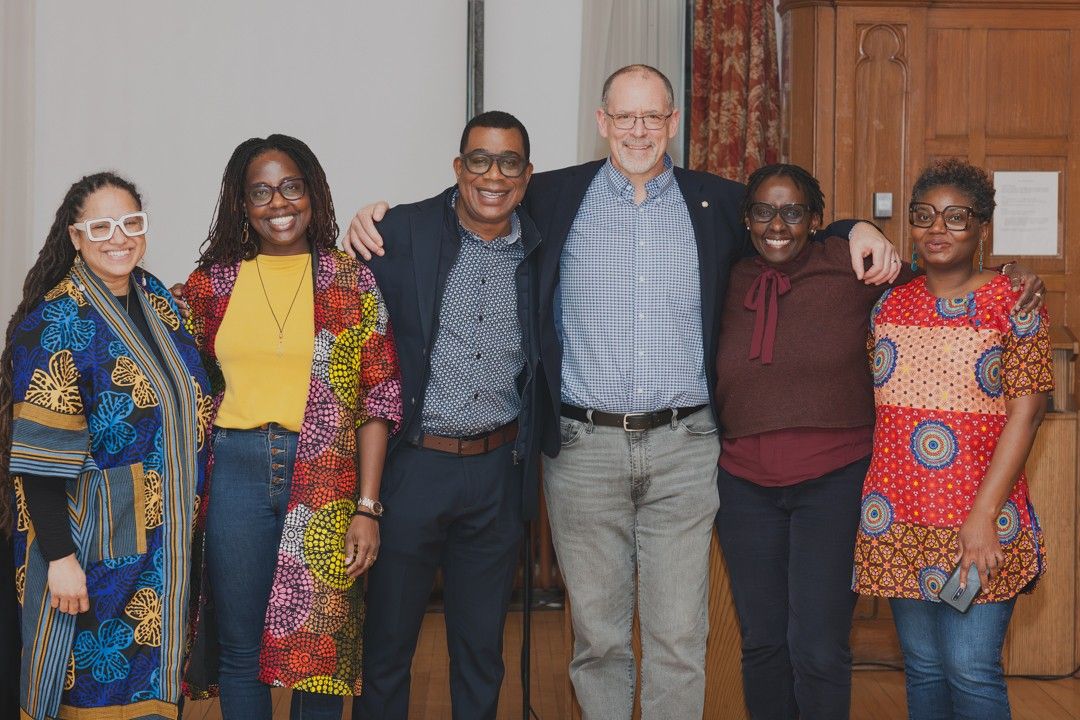
Earning Mentor awards this year were (l to r): jennifer s. leath, Kesha Fevrier, Leroy Baker, Juliane Okot Bitek, and Grace Adeniyi-Ogunyankin. Interim Dean Bob Lemieux (centre) was on hand for the award ceremony.
Awards recognize excellence in mentorship
For the fourth year in a row, the Black Excellence in Mentorship awards were presented at a ceremony held at the Ban Righ Centre.
This award is designed to acknowledge and reward exceptional examples of peer-to-peer mentorship, both formal and informal. The values and principles of the award are derived from recommendations in the FAS Strategic Plan, PICRDI Report, and reaffirmed through the Scarborough Charter.
“It really is an honour to celebrate and be celebrated,” says jennifer s. leath, host of the event and Undergraduate Chair of the Black Studies Program. “In the difficulties of life and the current condition of our world, it’s a strange thing to pause for joy, to pause for celebration, to pause even when there is disrepair, even when spaces are not just, and when we have not yet learned to coexist well. Still, there are those among us who are doing and have done the work and, for this, I am exceedingly and perpetually grateful. I’m glad to be in a community with colleagues who commit and recommit to these virtues of repair, just spatiality, and equitable coexistence – and the work they imply.”
The winners included:
Leroy Baker
Postdoctoral Fellow
Peer Mentorship Award
Leroy Baker's research centers on the challenges faced by Black university students with disabilities in Ontario. Through their mentorship, which emphasizes support for Black, neurodivergent learners often overlooked by a system that does not adequately serve them, they make a real difference.
According to one of his nominators, he has been tutoring and advising students who actively seek him out for mentorship at all levels of academic life—from course selection and supervisory relations to grant writing and paper presentations. His mentorship is bi-directional, rooted in mutual respect and trust, where mentees’ insights shape his own practice and advocacy.
Over more than a decade, this reciprocal approach has been consistent, impactful, and has helped build a more inclusive and supportive academic culture.
“When I was a student at the University of Toronto, I benefited from exceptional mentorship from my professors. I promised myself that I would one day extend that same support to others. That commitment ultimately inspired me to begin mentoring students at U of T,” Dr. Baker says. “Students of colour and students with disabilities are often overlooked or unsupported. We created a space where they can feel seen, encouraged, and equipped—not only through applying for external scholarships or attending conferences, but through the deeper, everyday support that truly shapes a student’s success. Today, I continue that work by mentoring both post-secondary and high school students.”
“My journey began in Jamaica, where hardship wasn’t just a circumstance—it was the atmosphere, I grew up in. Abandonment, abuse, and poverty shaped my earliest years, making survival feel like a daily challenge. When my father left at around age five, and my mother sent me to live with my grandmother, I entered a world where discipline came through fists, belts, and relentless cruelty. I grew up without a father, and I grew up working. By the age of 12, I was collecting and selling soft drink bottles and coconuts to earn a few dollars, which allowed me to stay in school. Eventually, the weight of it all caught up with me. My grades dropped, my confidence collapsed, and I eventually dropped out of high school at 15.”
“But along the way, there were people who helped me. When I immigrated to Canada, I began to understand that it wasn’t only race that shaped many of the challenges I had faced—it was also class, disability, migration, and the complex intersections of my lived experiences. Seeing these layers more clearly helped me make sense of my past and fuelled my commitment to pursue higher education.”
“Mentorship is not just something I do; it’s part of who I am. I believe that when students see themselves reflected in their mentors, they gain a sense of possibility. Representation matters. Support matters. Community matters. That’s why I continue to work with community organizations, speak at events, and advocate for equitable access to education. Everything I’ve achieved is rooted in the support I received and the communities that lifted me up. My vision now is to expand mentorship opportunities, strengthen pathways for marginalized students, and continue building spaces where they can thrive. Giving back isn’t an obligation—it’s a commitment to the next generation, and I will always make time for the communities I care about.”
Grace Adeniyi-Ogunyankin
Associate Professor and Canada Research Chair in Youth and African Urban Futures
Department of Gender Studies
Peer Mentorship Award
Nominator Anita Ragunathan says she started as the Black Studies Program Administrative Coordinator and within months, took on additional responsibilities as the Graduate Assistant. Grace was the Graduate Coordinator and helped her navigate the new role by walking her through the responsibilities. As someone who was new to academia, there was a lot of jargon and processes to learn and Grace was patient, thorough in her explanations, and generous with her time.
“As a colleague on the Black Studies Collective, Grace is always supportive and brings an infectious energy to the work that we do. Her insights are invaluable and she is a born leader in the way that she takes charge of difficult situations.”
Kristin Moriah, Muna Dahir, Yolande Bouka
Black Studies Summer Seminar — Organizing Committee
Department of English Literature and Creative Writing
The Black Studies Summer Seminar (BLK-S3tudies) is a comprehensive one-week research-intensive conference designed to produce generative and fruitful academic debates and professional development for PhD candidates, postdoctoral fellows, pre-tenure faculty, librarians, archivists, researchers and artists.
The goals of BLK-S3tudies include the training and development of PhD candidates, the support and preparation of pre-tenure faculty and the advancement of the field of Black Studies in Canada.
The nominees have all shown outstanding leadership in terms of grant preparation and outreach to graduate students and guest speakers. Their work has helped to shape the seminar from the ground up and created a unique Canadian institution.
Black Feminist Interludes Collective
Members include: Katherine McKittrick, Kesha Fevrie, Alana Butler, Yolande Bouka, Juliane Okot Bitek, Kristin Moriah, Vanessa Thompson, jennifer s. leath, and Grace Adeniyi-Ogunyankin.
This peer-mentorship group provides mentorship based on workshops, sharing experiences and strategies around black feminist knowledge production, pedagogical rehearsals and experimental methods, as well as through sharing space and creating collective well-being. It is a crucial space for black feminist faculty, in which we engage and learn together and mentor each other.
They organized writing retreats and publication workshops, as well as session in which we engage black feminist pedagogy and knowledge production. They also organize social events. Mentees feel less isolated and encouraged and empowered in their individual as well as collective projects.
Learn more about the awards on the webpage.