

Addressing global challenges through collaboration and learning
Queen’s University and Bader College have begun a long-term rewilding project at Herstmonceux Castle Estate, creating a unique opportunity for students to gain hands-on research experience in an international setting while contributing to a project addressing global environmental challenges. The initiative will transform 240 acres of ecologically depleted farmland on the 600-acre estate into a biodiversity haven, while opening new possibilities for research, teaching and learning, and collaboration.
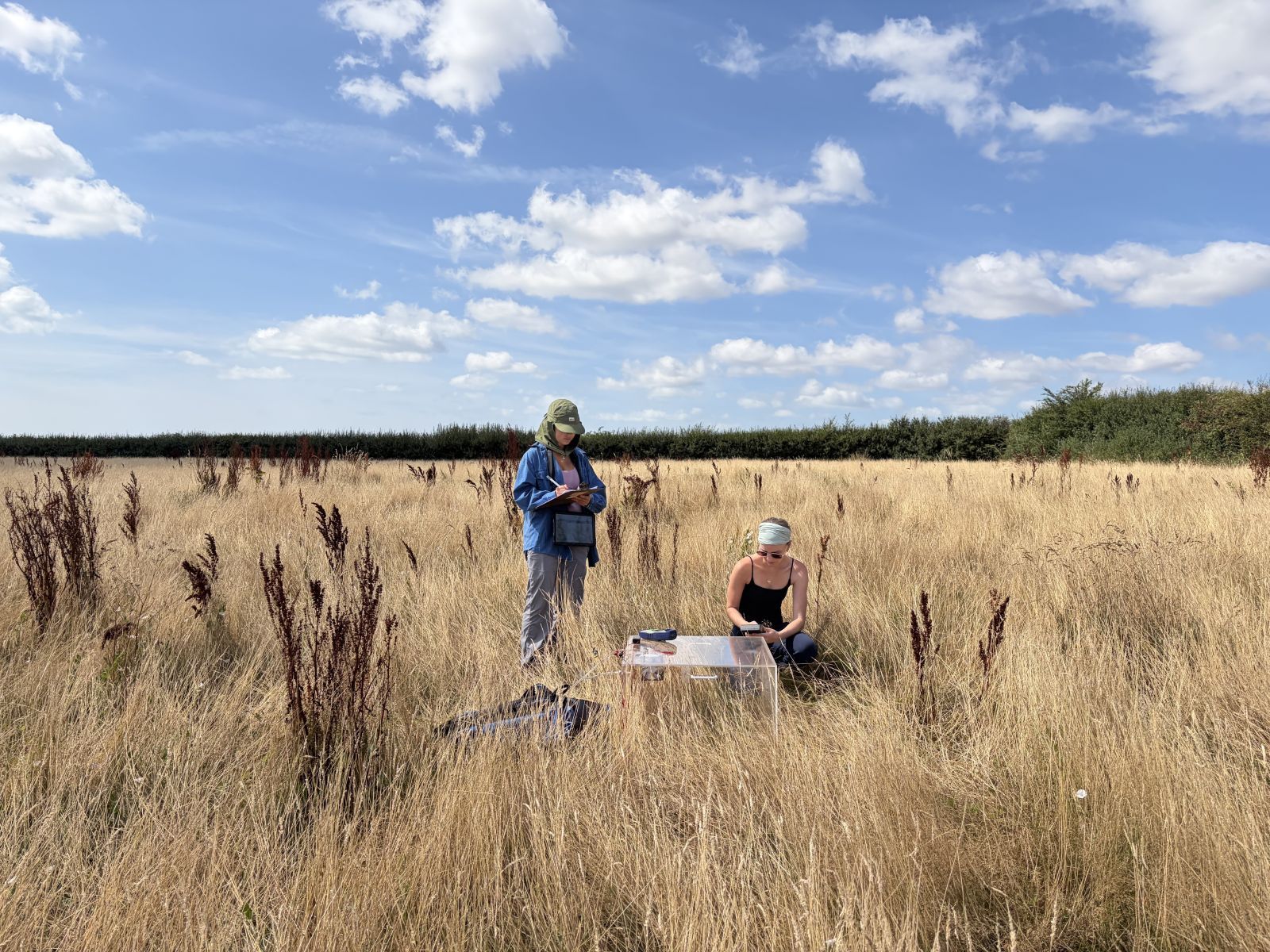
Faculty of Arts and Science researcher Ian Strachan and two of his students are contributing to the early stages of the rewilding project, gaining valuable international field research experience along the way. Environmental Science undergraduate student Maiyan Ross and Geography master's student Samantha Kimball, both members of Dr. Strachan's Atmospheric and Environmental Research (AER) Lab, spent the summer conducting research in the English countryside.
Both students are conducting hands-on fieldwork to investigate how rewilding affects the environment, measuring atmospheric gases, particularly carbon dioxide and nitrous oxide. "Those measurements are positive indicators that the rewilding is starting to work," Kimball explains. "If the land is getting more biodiverse, then ideally it will be sequestering more carbon and then contributing to climate mitigation strategies."
Kimball will be returning next summer to Herstmonceux to continue her research under Dr. Strachan’s supervision.
Ross says both students collected data together, but the research for her honours thesis is comparing the CO2 emissions of an abandoned agricultural crop field and a pasture. "I want to see how different land management practices and what the land was originally used for will impact the rate of carbon uptake. Are there different potential climate mitigation strategies for one field over the other?"
Both students also can’t say enough about Dr. Strachan’s commitment to undergraduate researchers. "I went to him with an interest in an undergraduate research project and he was so enthusiastic. If I'm confused or stressed about anything, he's supportive. He's a great leader," says Ross.
Noting that meaningful research experience can be difficult for undergraduate students to access, she says Dr. Strachan makes a point of involving undergraduates in his research and ensuring they have opportunities to gain hands-on experience.
Kimball emphasized that as a graduate student, involving an undergraduate student in her research project gives her an opportunity to mentor and share learning experiences.
Ross received an Undergraduate Student Summer Research Fellowship (USSRF) to fund her research. Dr. Strachan describes the program as a valuable way to connect promising undergraduate students with meaningful research opportunities.
For Dr. Strachan, the Herstmonceux project exemplifies the value of experiential learning, giving students the opportunity to put their classroom knowledge into practice in an international research setting. "The USSRF program is wonderful as it gives me exceptional students to be involved in hands-on research. This is all about taking the classroom into the field. It's an amazing opportunity all around.”
He adds that the rewilding project offers an opportunity to build something tangible at Herstmonceux, laying the groundwork for continued student involvement and future undergraduate research opportunities.