

Deal me in!
Making science accessible has always been a hallmark of the Arthur B. McDonald Canadian Astroparticle Physics Research Institute.
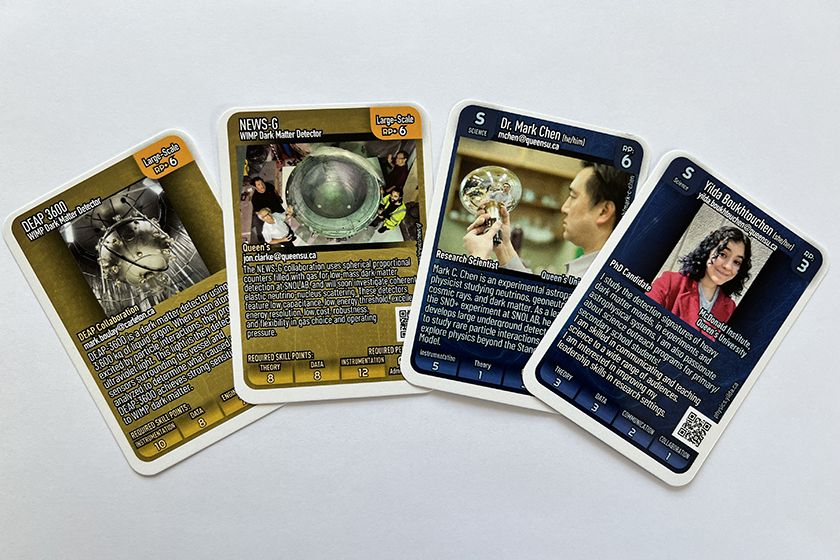
Communications Officer Zachary Kenny has taken this one step further by creating a unique card game that allows both young and old to learn more about scientific projects in Canada and the Canadian researchers working on them. Called the Astroparticle Physics Community Card Game, the open-source, community-driven project designed for the astroparticle physics research community and the general public.
Cards are available for downloading from the webpage, or the McDonald Institute offers sets of cards for free. The card features a photo of the researcher, information about them and their work, and a QR code that leads to their LinkedIn profile.
To build the cards, Kenny used inspiration from Queen’s Skills Cards, located on the Career Services website. Students can use the cards to highlight their skills and connect with future opportunities including interviews or job applications.
“When I first developed the cards, I was looking for a way to make networking fun for the research community, so the first iteration was a networking activity for an event, not a card game,” Kenny explains. “I ran a workshop at SNOLAB and asked all the participants to provide information for their cards prior to the event. I then printed a set of cards for them to use to network with other people at the event.”
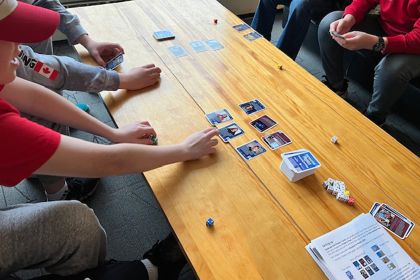
He then realized he could make it into a functional and educational game and has now created more than 192 cards, 29 project cards, 50 event cards, and 113 Personnel cards. Even Nobel Laureate Arthur McDonald (Physics, Engineering Physics and Astronomy) has a card in the deck.
“The cards are a versatile tool for networking,” says Avani Bhardwaj, PhD candidate (Physics, Engineering Physics and Astronomy). “You can use them to play a game or just use them as a revamped way of exchanging business cards. If you're really into the research going on at the institute, they also double as cool collectibles, especially the cards for the different experiments.”
To play the game, researchers must be matched with various Canadian scientific projects, such as the dark matter experiment, NEWS-G, or the deep-sea neutrino detector, P-ONE. A number of these projects were submitted by the scientific community while others were developed by personnel at the McDonald Institute.
When asked about distribution plan and plans for the future, Kenny says he’s focused on two strategic purposes – networking opportunities for the research community and working with elementary and early high schools to get the card game in the hands of students.
“We just held the Ontario Association of Physics Teachers conference. I gave away 200 decks of cards - each deck can be played by a group of two to four students. I’ve been in touch with those teachers to encourage them to play the game in their classrooms. That’s really the target audience for the game itself. All of these people are Canadian researchers, and they are all Canadian projects which is an eye-opening moment for the students. We also really focus on representation of all types of scientists so the students can see themselves in the cards.”
Learn more about the Astroparticle Physics Community Card Game by downloading the Game Guide from the website.
Contact Zachary Kenny or visit the McDonald Institute Visitor’s Centre to obtain a set of pre-printed cards.