

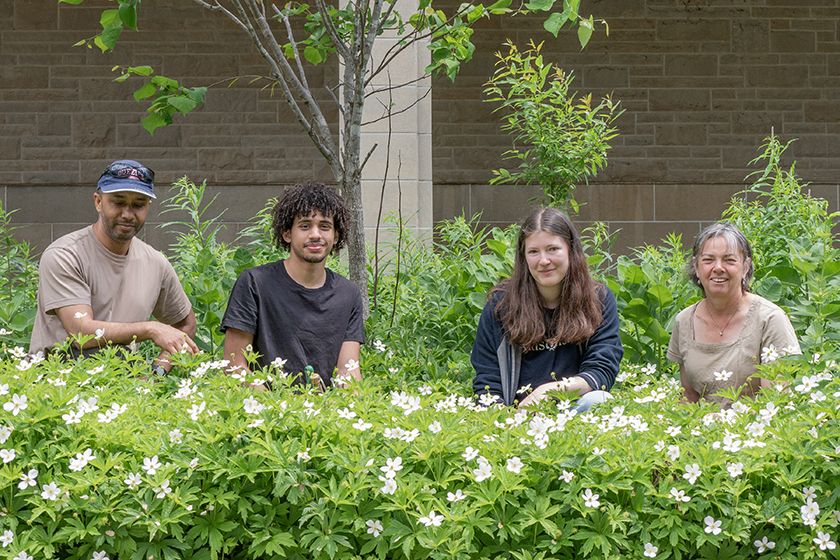
Dr. Baharul Choudhury, Abdur-Raheem Mohamed, Julia Atteck, and Dr. Vicki Friesen pose with some of the plants on campus.
Exploring plants on campus
During the summer of 2025, two Summer Work Experience Program (SWEP) students Isabelle Price and Amelie Hughes completed the Queen’s University campus mapping project by surveying thousands of plants across the Queen’s campus.
The four-month project distinguished native versus non-native trees and plants across main and west campuses. The intention of this project was to document the campus plant diversity, determine areas where native biodiversity thrives and identify regions where non-native plants may be lacking.
After documenting 4,612 individual plants representing 477 species, their findings showed that only 36 per cent of species on campus are native, while 64 per cent are non-native or invasive. View these results through the interactive map. The mapping project revealed several areas with higher numbers of native plants, including the Biosciences Native Pollinator Garden, the southeast corner of Tindall Field, and the Snodgrass Arboretum.
“I got involved in the project because I was interested in increasing awareness for plant species biodiversity and conservation on campus,” Isabelle explains. “Through this project, we were able to highlight areas of high and low native and non-native plant species to identify areas where biodiversity was lacking. One highlight from this project was to see how much our campus contributes to native pollinator habitats. I’m proud that this work will provide a valuable resource for future researchers and campus staff as they make planting and conservation decisions that support native species.”
Overall, the top five most common species were Norway maple, Kentucky bluegrass, dandelion, Siberian elm, and white clover.
“It’s important to know what’s on our campus in terms of biodiversity,” Dr. Baharul Choudhury (Department of Biology) explains. Along with Dr. Choudhury, the project was co-supervised by Dr. Vicki Friesen (Department of Biology) along with Julia Atteck of the Society for Conservation Biology (SCB) Kingston Chapter. “The two students selected were really motivated and even created the interactive map, so their findings were more easily understood.”
“I got involved in this project because I was interested in building an interactive map to help support conservation efforts at Queen's,” Amelie says. “Over the summer, I learned a lot about plant identification through fieldwork and GIS. It was rewarding to see how much we had accomplished as all of the data came together. I was especially happy to see areas that stood out for having a high presence of native plant species, such as the native pollinator garden in front of the Biosciences Complex.”
The findings from the project appear on the SBC website, and the project results are available for download.
“This will help the policymakers and those who work on campus to decide on how to improve the biodiversity and possibly bringing in more native species,” Dr. Choudhury says. “The report also proposed longer term monitoring and an improvement process.”
Because campus biodiversity changes from year to year, especially with unusual conditions such as the hot, dry summer of 2025, it will be important to continue monitoring and updating this work. With ongoing collaboration among students, researchers and campus operations, Queen’s may become a leader in native biodiversity stewardship among Canadian universities.
Learn more about the SWEP program on the webpage.