

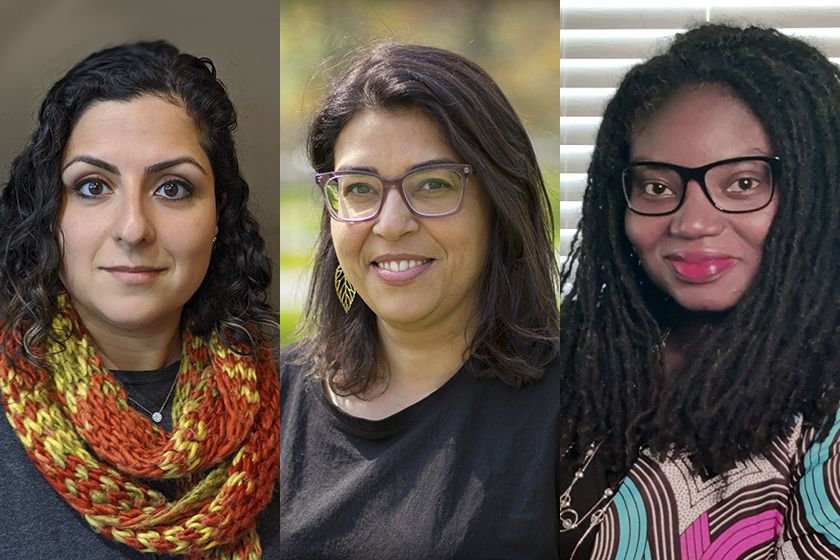
From left: Farnaz Heidar-Zadeh, Monica Castelhano, and Grace Adeniyi-Ogunyankin.
Funding to boost innovative interdisciplinary research
By Catarina Chagas, Manager, Strategic Communications and Outreach
Many of the challenges faced by people in Canada and worldwide cannot be solved by a single research discipline, which is why researchers need to work collaboratively and creatively on how to approach these issues. On May 13, the Government of Canada announced a $23 million investment through the New Frontiers in Research Fund – Exploration (NFRF-E) competition, which supports high-risk, high-reward research that pushes boundaries and brings together diverse disciplines in unexpected ways. Three Queen’s researchers secured a total of $750,000 in funding. As part of the same announcement, Grace Adeniyi-Ogunyankin (Geography and Planning, Gender Studies) was renewed as the Canada Research Chair in Youth and African Urban Futures.
Each Queen’s-led project received $250,000 from the NFRF-E program.
Farnaz Heidar-Zadeh’s (Chemistry) research will integrate quantum simulations, machine learning, and, ultimately, automated robotic labs to accelerate the experimental and computational development of N-heterocyclic-carbene stabilized gold nanoclusters for cancer therapy, with a particular focus on tumours resistant to conventional treatments. “These gold nanoclusters are stable, metal-binding compounds that are attractive for their safety, tunability, and tumor-targeting potential, making them a promising platform for next-generation precision oncology,” she says.
Monica Castelhano (Psychology) will lead a study exploring new approaches to improving the diagnosis of autism in adults. Bringing together insights from psychiatry, cognitive science, machine learning, and film/media, the project will examine whether eye movement behaviour may help reveal subtle differences in social processing. The team will produce videos depicting subtle, complex social exchanges and collect eye movement data from autistic and neurotypical adults while they watch the videos. “Our pilot data show clear temporal differences in how autistic and neurotypical adults process social interactions,” says Dr. Castelhano. “This project seeks to provide clinicians with a practical, evidence-based tool that improves recognition of autism in adults, particularly those with subtle or atypical presentations.”
Grace Adeniyi-Ogunyankin, a Tier 2 Canada Research Chair, will receive $500,000 over five years to expand her research on how contemporary urban transformation impacts the identity, labour practices, psychosocial wellbeing, and future orientation of African youth. She will build a research network of scholars and practitioners interested in investigating how the intersections of global consumer culture, social media, and urban development affect African youths’ future-making practices. “The focus will be on the realities of precarity, while also considering other everyday creative, leisure and aesthetic practices that are outside of, and against, precarity,” says Dr. Adeniyi-Ogunyankin.
Wei Tu (Canadian Cancer Trials Group and Public Health Sciences) is developing new ways to measure how cancer patients feel and function during their cancer journey, capturing their quality of life, symptoms, and ability to carry out daily activities. These patient-reported outcomes matter deeply: they reveal whether a treatment is truly making a difference in people's lives, beyond what medical tests alone can show.
To learn more about the funding announcement, read the Government of Canada media release.