

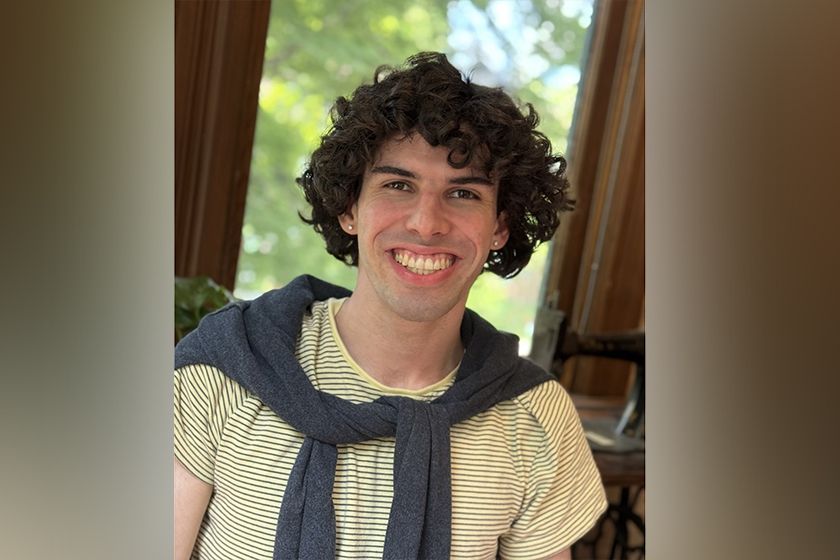
Classics and Archaeology Masters student Robert Carrusca recently earned the Masters Student Abstract Award at a conference hosted by the University of Alberta.
Exploring the mysteries of ancient Greece
Faculty of Arts and Science Masters student Robert Carrusca recently earned the Masters Student Abstract Award at a conference hosted by the History, Classics, and Religion Graduate Student Association at the University of Alberta.
The theme of the conference was Memory and Narrative and included a series of panels of various sub-themes on scholarly work examining the past through the lens of memory and narrative.
The first year Masters student’s presentation was entitled Autochthonic Apparel: The Recollection and Curation of the Athenian Past through the Caryatids of the Erechtheion which was a part of a panel of scholars focusing on memory and its use in constructing state identity. The Caryatids of the Erechtheion are six iconic fifth-century BCE sculpted female figures that serve as architectural supports (columns) on the south porch of the Erechtheion temple on the Athenian Acropolis. Draped in peplos garments (a traditional, sleeveless garment worn by women in ancient Greece) these 2.3-meter-tall Pentelic marble maidens combine structural function with artistic beauty.
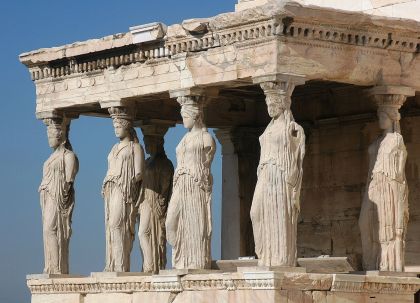
For his presentation he also had a small sample of textile to illustrate the colorful nature of the statues, and how colour too was used to serve as visual shorthand invoking memory.
“My paper was focusing on how the clothes on those statues were intentionally evocative of an earlier time,” Carrusca (Department of Classics and Archeology) explains. “A comparable example would be how today when official politicians have busts, they often portray them wearing more traditional clothing than perhaps jeans and a t-shirt. That was essentially my argument in my paper – what sort of message are you portraying if you depict something that’s a visible form of architecture in a historic style.”
Carrusca says he applied to the conference and attended in person. “It was the theme of the conference that stuck out to me. The theme was memory and narrative, talking about how clothing can serve as memories or a public sort of recollection. It seemed applicable to the paper that I had written.”
When asked what drew him to Queen’s, Carrusca says when he finished his undergraduate degree at the University of British Columbia, he found he was drawn to ancient history, when he originally thought he would major in the 19th or 20th century Canadian or European history.
“I am really interested in the clothing aspect of the ancient world, specifically ancient Greece, and I was looking to explore topics that hadn’t really been talked about,” he explains. “I also have a passion for historic clothing and clothing recreation, ranging from the early modern period to the 1930s but also the ancient Greek and Roman worlds.”
Carrusca says earning the award for his paper is incredibly motivating, and being there in person also introduced him to academics in other disciplines working in a similar area. “It was very inspiring and I found I kept having to write ideas down that I developed listening to the other speakers. I hadn’t experienced a conference like this before, and it made me think of not only areas of interest for my thesis but other potential ideas for new papers. It was an amazing experience being exposed to these branches of thought.”