
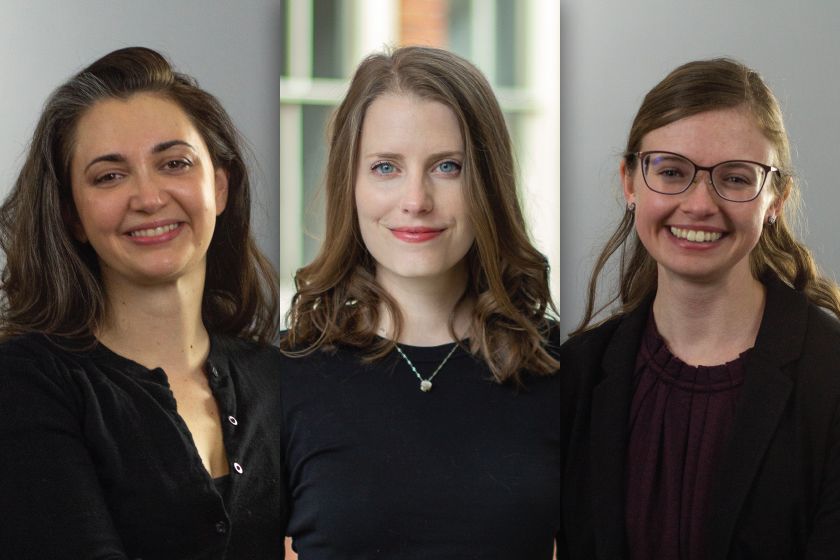
From left: Zoe Brisson-Tsavoussis (Department of Physics, Engineering Physics & Astronomy), Michele Morningstar (Department of Psychology), and Taylor Rae Morrell (Department of Geological Sciences and Geological Engineering).
Shaping our future, advancing equality
The Faculty of Arts and Science is once again recognizing UNESCO’s International Women and Girls in Science Day, a global event celebrating women in science and shaping a future where science and gender equality advance together.
An education in science develops critical thinking, problem-solving, and data analysis skills, while fostering curiosity and creativity to understand the world and drive innovation. Science programs at Queen’s prepare individuals for diverse careers, promoting informed decision-making on complex issues, and building lifelong learning habits for a rapidly changing world.
According to the UNESCO website, women continue to represent less than one third of the world's researchers. Queen’s University is strengthened by a vibrant community of champions for female-led research and academic excellence. We interviewed three FAS researchers teaching and researching in the Science, Technology, Engineering, and Math (STEM) field about their academic journey, mentorship, and challenges they have faced.
When Michele Morningstar (Department of Psychology) was a child, she wanted to be a teacher, a writer, and a psychologist. “I was first driven to study psychology by the desire to help others navigate life’s challenges but developed a passion for research during my undergraduate and graduate studies,” Dr. Morningstar says. “My lab, the Development of Social & Emotional Communication lab, now seeks to understand how children and adolescents learn to interpret emotions in others, and to express their emotions effectively. I find it extremely validating to know that the research my team conducts can contribute to our broader understanding of how these key socio-emotional skills develop.”
Mentorship in a common theme for many academics in FAS. Dr. Morningstar says she has had many supportive mentors throughout her academic training, including other women working in science This has led her to champion women’s career development in STEM spaces, such as the intersection of developmental psychology and neuroscience in graduate studies and beyond.
"Providing mentorship to other women in science is important to me. Although psychology as a field attracts many women, there are also interdisciplinary spaces or career stages in which women are less well-represented than you might expect. Identifying, and pushing back on, the implicit biases people hold about women’s work in STEM teaching and research is one of the ways I can contribute to a more inclusive and positive culture for the next generation of scientists.”
And a message for girls and young women interested in a career in STEM? “STEM research is incredibly rewarding; it is curiosity-driven, often team-based, and impactful. Despite its challenges, I often tell others that I have the best job in the world. My best advice for women in STEM is to rely on your mentors and your peers: having a solid group of trusted colleagues will help you understand and navigate any gender-specific challenges of working in STEM. Our science community is increasingly welcoming of diverse researchers; having a wide variety of perspectives, skillsets, and experiences undoubtedly makes our science better.”
Taylor Rae Morrell (Department of Geological Sciences and Geological Engineering) is a PhD candidate in structural geology tectonics.
“My research focuses on how pre-existing faults can influence the evolution of mountain systems,” Morrell explains. “Specifically, I look for changes and discrepancies in the rocks and how they have deformed over top of the pre-existing faults. My research has taken me to the remote Himalayan mountains of India and the rural North American Cordilleran mountains in northern Idaho, USA.”
Again, mentorship is an important aspect of her academic work and says mentoring younger graduate students and undergraduate students is a passion of hers. “I strive to be an open and approachable presence in the department. It is especially important for undergraduate students to see a confident female in field geology, but who can also be approachable for the uncomfortable, but necessary questions that come with being a female field geologist doing remote field work. One of my favourite memories is a presentation I gave to the second-year cohort about doing field work. A lot of the female undergraduate students ask about doing remote field work in foreign countries as not only the lead geologist, but also as a young woman. It was a presentation I wish I could have received when I was in their seats.”
When asked to provide encouragement for girls and young women interested in a career in STEM, Morrell has a strong message.
“Gone are the days when geology was only for older, white men. Geological sciences can be a hard, and messy research area, but women have proven for ages that we can do hard and messy work. Never mind those who question whether women enjoy outdoor work or digging in the dirt beyond the backyard sandbox; geological sciences is a diverse research area and requires a diverse workforce to tackle the research questions we encounter. Always remember to lift those around you and behind you up — you stand on the shoulders of those that had to push forwards alone.”
Zoe Brisson-Tsavoussis (Department of Physics, Engineering Physics & Astronomy) had an interesting journey to where she is currently is academically. The PhD candidate says there was only one woman working in her undergraduate department, off by herself doing research in theoretical dark matter.
Brisson-Tsavoussis explains she approached her new mentor for support, who helped her apply for a grant to allow her to work with her over the summer, learning about astroparticle physics.
“Now, I’m doing a PhD in experimental particle physics,” she says. “I work on a telescope buried deep in the Antarctic ice, that uses the kilometres of clear ice as a kind of lens to look for traces of a very small, very inert particle called a neutrino. It’s just like collecting light particles in a normal telescope, except that detecting these particles from other galaxies and cosmological bodies tells us a whole different story than light can.”
Along with her success and the success of those around her, Brisson-Tsavoussis says there are still significant challenges ahead.
“There is still substantial sexism and racism in the hard sciences. It’s evidenced by the ‘leaky pipeline’. Among physics faculty in American four-year colleges and universities, women represent 23 per cent of assistant professors, 18 per cent of associate professors and just 10 per cent of full professors (view the report). We face a system that is less flexible towards primary caretakers and birth-givers. Gender minorities face constant microaggressions, especially gender minorities of colour. I’ve watched people sit around a table, completely ignore the comment of a woman of colour only for the same comment to be repeated minutes later by a white man – and the comment is listened to, as if it was his own. It is hard enough to be constantly pushing the boundaries of human knowledge – why are we also fighting to be heard by our own peers?”
Looking at young women interested in a career in STEM, she tells them to stay focused, even though there will be a thousand reasons to stop and only a few to keep going.
“Do what you can, it doesn’t need to be perfect. You don’t need to be perfect. Make mistakes, get messy, dig your way into a hole, and figure out how to crawl out of it. Find resources – it takes time and energy, but some bureaucrat needs to look good by giving you free money. Find it and fight for it. Find allies – someone out there will have had a similar experience to you, and talking to them will help you feel validated and stay sane. But at the end of the day, listen to yourself. You’ll know what’s best for you.”
Learn more about International Day of Women and Girls in Science on the website.